
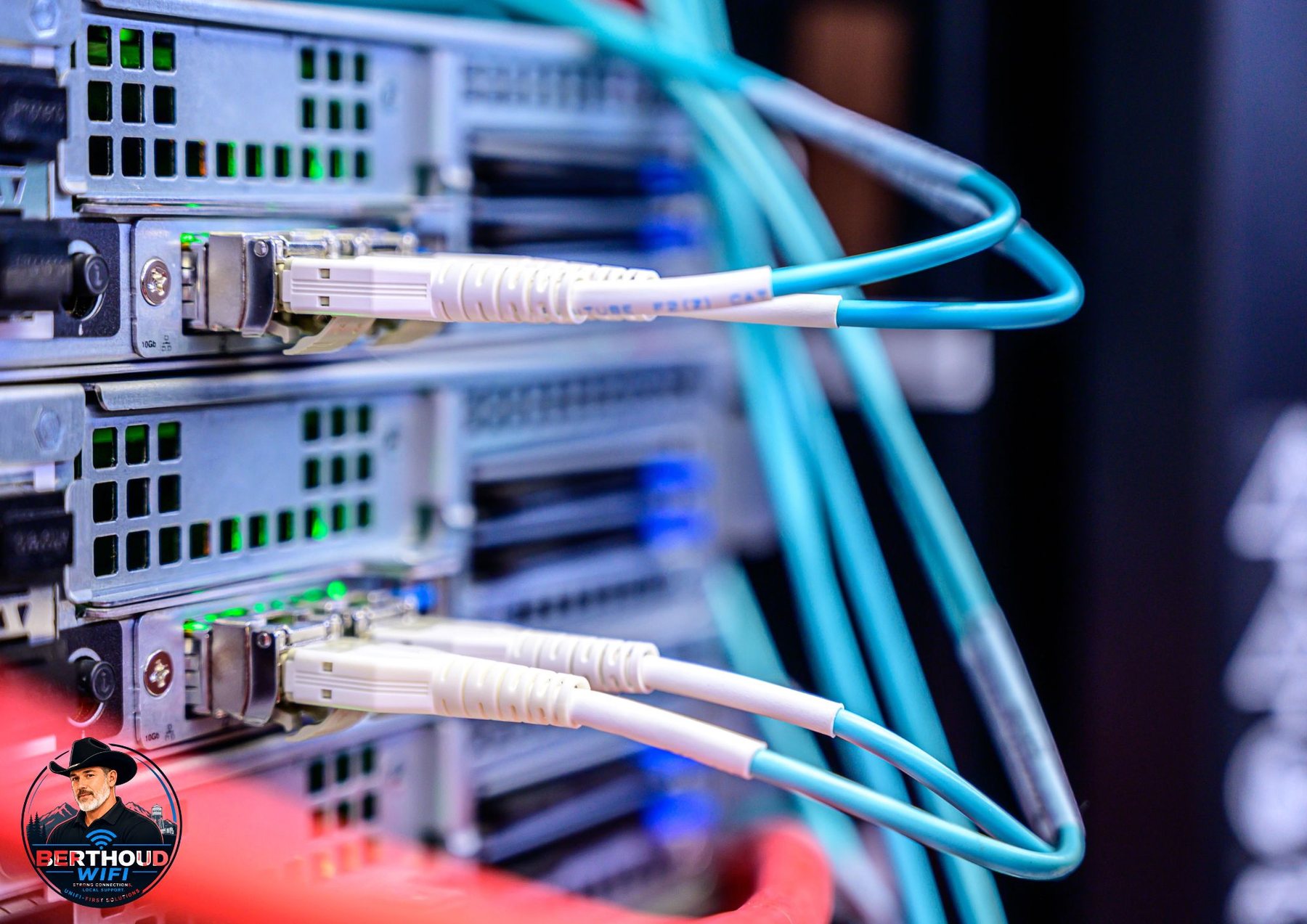
Fiber and copper Ethernet are complementary technologies. The correct choice depends on distance, power needs, electrical isolation, bandwidth, environment, pathways, and endpoint devices.
When Ethernet is the practical choice
Copper Ethernet connects access points, cameras, phones, workstations, printers, and other devices while also supporting PoE. It is straightforward for room and endpoint runs within standard distance limits.
Managed switches can provide central power and visibility for connected devices.
When fiber provides an advantage
Fiber can span longer distances, carry high-capacity links, and provide electrical isolation between buildings. It is well suited for backbones, switch uplinks, remote network closets, and multi-building properties.
Fiber does not conduct electricity, which is valuable between separate structures.
Building-to-building connections
Fiber is an excellent permanent connection when conduit or trenching is available. A wireless bridge may be considered when digging is impractical.
The remote building usually converts the fiber or bridge connection into Ethernet through a switch for access points, cameras, and wired devices.
Power considerations
Fiber does not deliver PoE to endpoint devices. Remote buildings need local power for switches and connected equipment.
Copper Ethernet can power access points and cameras, but distance and surge exposure must be considered.
Hybrid designs
Many professional networks use fiber between switches and copper Ethernet from the switch to endpoints. This combines strong backbone performance with PoE at the edge.
We design the mix around the property rather than forcing one cable type everywhere.
Serving Northern Colorado
Berthoud WiFi is based in Berthoud and provides this service throughout Loveland, Fort Collins, Longmont, Erie, Boulder, Windsor, Johnstown, Timnath, Mead, Frederick, Firestone, Wellington, Greeley, and nearby communities.
Frequently asked questions
Can fiber power an access point?
No. Fiber carries data but not PoE. A local switch or media equipment with power is required.
Is fiber always better between buildings?
It is often the strongest permanent option, but trenching, conduit, distance, and budget affect the decision.
Can Ethernet connect two buildings?
It may be used in properly designed pathways, but electrical isolation, distance, and surge exposure should be evaluated.
Can one network use both fiber and Ethernet?
Yes. Fiber is commonly used for uplinks and Ethernet for endpoint devices.
Related services and guides
Ready to improve the network?
Tell us about the property, the current problem, and what the finished system needs to support.
Request a Quote