
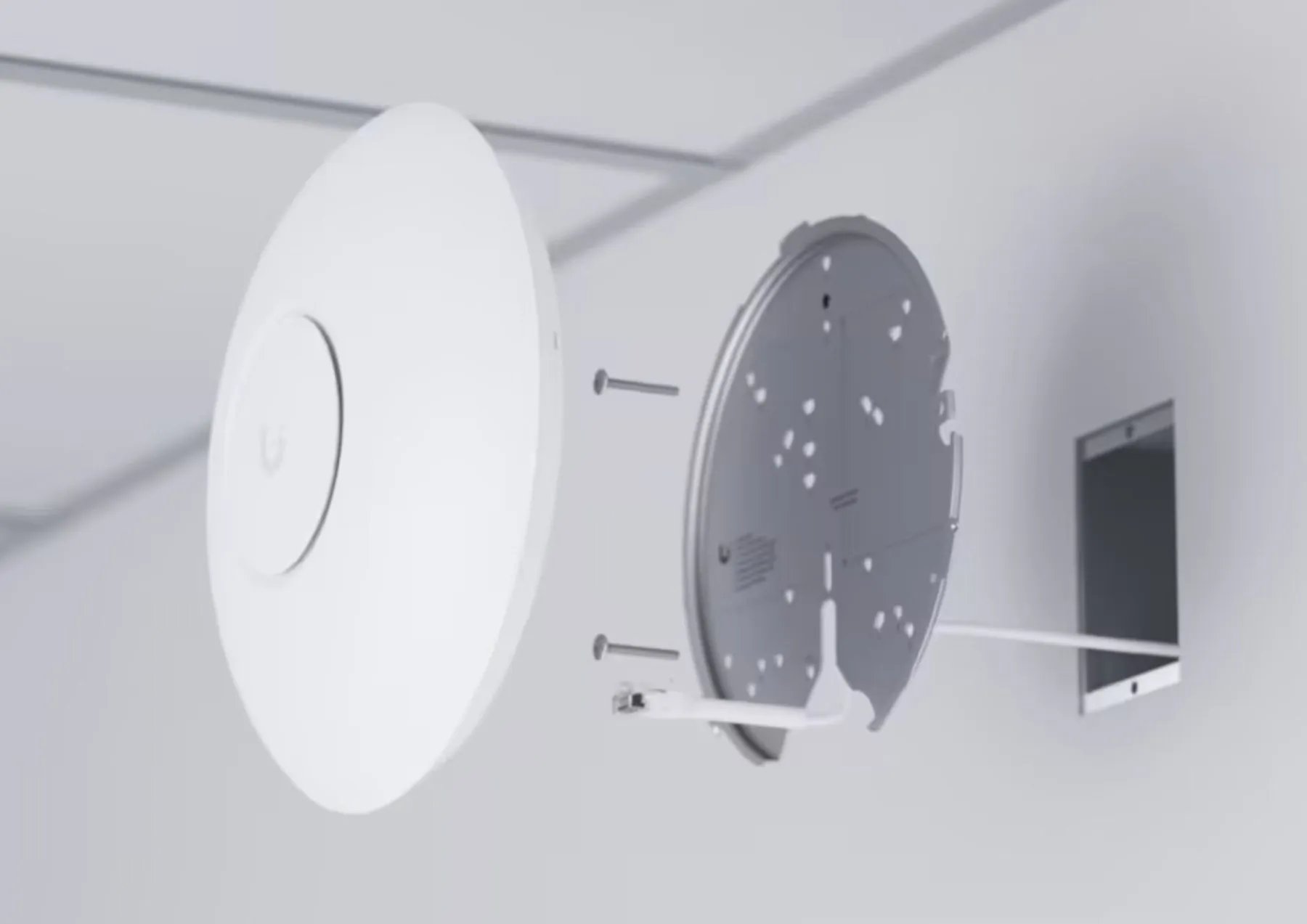
WiFi 7 is newer, but newer does not automatically mean better for every property. U6 access points remain strong choices, and some models offer radio configurations that perform very well in homes and businesses.
Why the WiFi generation is only one factor
Access-point performance depends on radio design, antenna pattern, channel width, interference, client capabilities, placement, and backhaul. The generation number alone does not determine coverage or real-world speed.
A newer 2x2 design may not replace every use case served well by a U6 model with a different radio configuration.
Where U6 models still make sense
U6 access points are a strong fit for many homes, offices, churches, shops, and existing gigabit networks. They support a wide range of client devices and can deliver dependable performance without requiring multi-gig switching.
Models differ, so recommendations are based on the specific access point rather than treating the entire U6 family as identical.
When U7 may be worth considering
U7 models may be appropriate when the property has newer clients, expects 6 GHz use, needs higher aggregate capacity, or is being designed around multi-gig switching and cabling.
The gateway, switch ports, PoE capacity, Ethernet cabling, and internet service should support the intended benefit.
Coverage versus capacity
A high-capacity access point does not necessarily cover a larger area. More access points at appropriate power and placement may perform better than one device attempting to reach the entire property.
We design around where users and devices are located, including weak-radio IoT clients.
Berthoud WiFi recommendation process
We review construction, square footage, floors, client count, device types, internet speed, cable pathways, and budget. The proposal explains why a specific U6 or U7 model is recommended.
Customers are not pushed toward WiFi 7 when U6 is the more practical choice.
Serving Northern Colorado
Berthoud WiFi is based in Berthoud and provides this service throughout Loveland, Fort Collins, Longmont, Erie, Boulder, Windsor, Johnstown, Timnath, Mead, Frederick, Firestone, Wellington, Greeley, and nearby communities.
Frequently asked questions
Is WiFi 7 always faster?
Compatible clients and infrastructure can benefit from newer features, but real-world performance depends on many factors beyond the generation.
Will older devices work with U7 access points?
Many older devices can connect through supported legacy bands, but they do not gain WiFi 7 capabilities.
Do U6 access points still make sense in 2026?
Yes. U6 models remain practical for many homes and businesses.
Do I need multi-gig switching for U7?
Not every installation requires it, but multi-gig uplinks may be needed to realize higher aggregate throughput on selected models.
Related services and guides
Ready to improve the network?
Tell us about the property, the current problem, and what the finished system needs to support.
Get a quote